

We don't like to talk bad about the worst companies, because there are bad customers out there as well, and you hear much more about the worst complaints than the best – even 5x more.
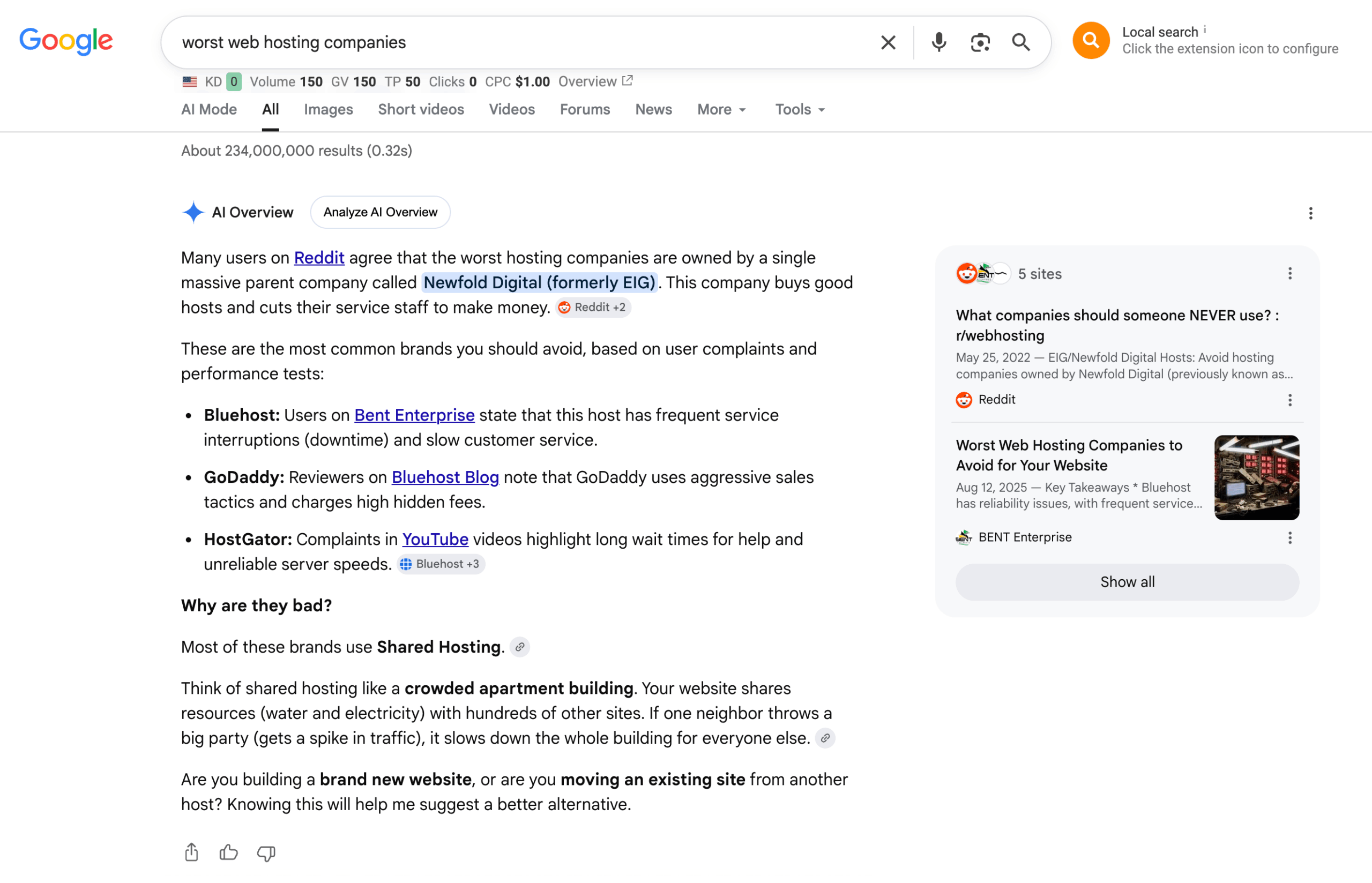
But when I Googled this I saw a funny Google AI Overview that literally said:
“Many users on Reddit agree that the worst hosting companies are owned by a single massive parent company called Newfold Digital (formerly EIG). This company buys good hosts and cuts their service staff to make money. [1, 2, 3]
These are the most common brands you should avoid, based on user complaints and performance tests:
HostGator: Complaints in YouTube videos highlight long wait times for help and unreliable server speeds. [1, 2, 3, 4]
Bluehost: Users on Bent Enterprise state that this host has frequent service interruptions (downtime) and slow customer service.
GoDaddy: Reviewers on Bluehost Blog note that GoDaddy uses aggressive sales tactics and charges high hidden fees.”
Here is the screenshot proof of that:
What's interesting about this is more an observation of where we're heading in the new AI era. Bad opinions of companies – web hosting or not – are harder to bury.
Before, users could leave negative comments on TrustPilot or Reddit but the comments would often get buried. Now, AI systems synthesize from many sources big and small. And what the AI things, is that Newfold Digital (formerly EIG) web hosting companies are the worst! That's not my opinion, just a screenshot here.
I will say, Bluehost and HostGator were fine when I used them last, but it's been a while. They are like McDonald's and Burger King compared to a filet mignon. They're meant to be cheap and give you just the basics for like a few dollars a month.
What Reddit Says are the Worst Hosts
I hopped over to Reddit out of curiosity and saw a lot of content that made up that Google AI Overview. Super interesting how so many of us now have a distributed, federated voice to have a positive change by calling out bad companies.
I've been on the wrong end a few times, and when you are wronged by a company, you feel powerless. The internet, and now AI, are a way to get your anger out productively by warning others.
Here's a screenshot of that:
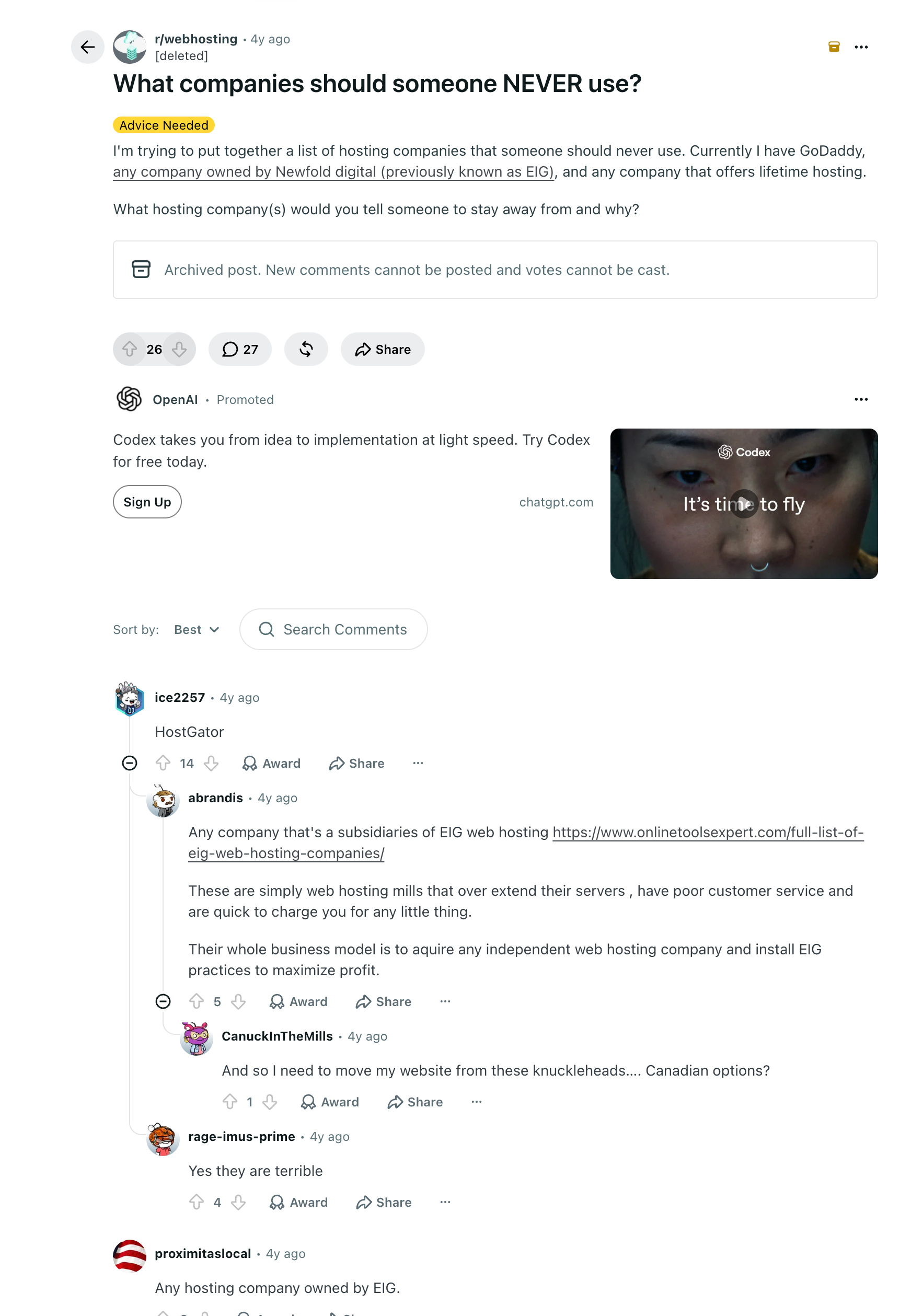
So we know what AI and Reddit thinks, but what if we wanted to ground the answer in our own research and opinions? We attempt that in this post.
My own Checklist for What I Think are the Worst Web Host Attributes
If I were to define what would make the worst host based on my experience, it would really come down to a few things:
- Was the uptime so bad, so often, that it took down my site and harmed my business?
- Was there something that went really wrong – a hack, cybersecurity issue, something really bad – that was too hard to resolve, too slow to resolve?
- Is the web hosting support and customer service bad beyond a red line?
- Is the support bad compared to others?
- Was there an auto-billing for a year at a really high price that the user was unaware of
- Are there tools and dark patterns that make it impossible for you to cancel?
These are the top questions I would run through, based on my knowledge. This is my own opiniated list, but I built it thinking back to 15 years of the worst web hosting experiences, including that one time I deleted a client's website.
Building my Personal Ranking of the Worst Web Hosting Companies
I had a proprietary machine learning + NLP-powered system take these, do deep research, and cite popular companies against those 6 questions, score them with weights and then give a final scoring in an objective way and cite sources, here's that table with a few summary points.
The multiplicative model is intentional and separates the winners from the losers: it's deliberately unforgiving; one catastrophic weakness can collapse the entire score. A technically solid host cannot average away predatory renewals, impossible cancellations, tons of downtime, or disastrous incident handling. I built this off of how Google does its own bid-based ranking.
Now, according to this ranking, the bottom five are:
- Bluehost 5.86,
- Hostwinds 5.62,
- OVHcloud 5.03,
- GoDaddy 3.62,
- Network Solutions 2.64. (Worst)
Here's the Worst Hosts Ranking Table, the Bottom 10:
Here we've pulled out the worst 10 from the list of the top 25 most popular hosts.
The 10 Riskiest Popular Web Hosts
Scores combine uptime harm, security recovery, support quality, renewal transparency and cancellation ease. A low score means one or more recurring failures are severe enough to create material business risk.
| Risk rank | Provider | Score /10 | Risk level | Biggest red flag | Bottom line |
|---|---|---|---|---|---|
| #1 | Network Solutions | 2.64 | Severe risk | Support vs. peers: Among worst | The clearest avoid in the grid: support quality, renewal opacity and cancellation friction are severe enough that acceptable uptime cannot rescue the score. |
| #2 | GoDaddy | 3.62 | Severe risk | Security recovery: Multi-year intrusion campaign | A major security outlier: GoDaddy disclosed multiple related compromises in a multi-year campaign. Billing and exit friction compound the risk. |
| #3 | OVHcloud | 5.03 | High risk | Support vs. peers: Below average standard tier | Infrastructure value can be attractive, but standard-tier support and cancellation/escalation complaints make it risky for nontechnical businesses. |
| #4 | Hostwinds | 5.62 | High risk | Renewal transparency: Recurring billing surprises; Cancellation ease: Billing disputes complicate exit | Technical support can be helpful, but billing, suspension and cancellation disputes create a material tail risk. |
| #5 | Bluehost | 5.86 | High risk | Renewal transparency: Auto-renews early; price jump | Acceptable mainstream hosting, but renewal mechanics, early auto-renewal, product separation and average support create avoidable friction. |
| #6 | HostGator | 6.16 | Elevated risk | Renewal transparency: Sharp renewal increase | Operationally adequate, but the classic low-intro/high-renewal model and multi-step cancellation workflow reduce trust. |
| #7 | WP Engine | 6.28 | Elevated risk | Cancellation ease: Serious post-cancel billing reports | Technically excellent, but recurring recent complaints about annual commitments, overages and charges after attempted cancellation materially damage the trust score. |
| #8 | IONOS | 6.74 | Elevated risk | Renewal transparency: Price changes and upsells | Large, capable infrastructure with decent support; scores are held back by uneven service experiences and pricing-change friction. |
| #9 | HostPapa | 6.78 | Elevated risk | Renewal transparency: Extremely high renewals | Service and support are usually strong, but some renewal prices are so high that they become the dominant consumer-risk factor. |
| #10 | GreenGeeks | 7.11 | Generally solid | Renewal transparency: Auto-renew; no renewal refund | Support is a meaningful strength, but weaker shared-host load performance and unforgiving renewal-refund terms reduce the score. |
Scoring: 10 means low consumer and business risk; 0 means a severe recurring failure pattern. Final scores use a multiplicative model, so a catastrophic weakness cannot be averaged away.
Here's a Breakdown of the Worst 5 Web Hosts:
Ready to go a bit deeper into the muck? Here's a closer look at why these 5 scored worst.
The Bottom Five Web Hosts in the 25-Provider Risk Study
These providers finished at the bottom because support, security response, billing transparency or cancellation friction became severe enough that acceptable infrastructure could not rescue the final score.
| Risk rank | Provider | Final score | Why it finished here |
|---|---|---|---|
| #1 worst | Network Solutions | 2.64/10 | The clearest avoid in the grid: support quality, renewal opacity and cancellation friction are severe enough that acceptable uptime cannot rescue the score. |
| #2 worst | GoDaddy | 3.62/10 | A major security outlier: GoDaddy disclosed multiple related compromises in a multi-year campaign. Billing and exit friction compound the risk. |
| #3 worst | OVHcloud | 5.03/10 | Infrastructure value can be attractive, but standard-tier support and cancellation/escalation complaints make it risky for nontechnical businesses. |
| #4 worst | Hostwinds | 5.62/10 | Technical support can be helpful, but billing, suspension and cancellation disputes create a material tail risk. |
| #5 worst | Bluehost | 5.86/10 | Acceptable mainstream hosting, but renewal mechanics, early auto-renewal, product separation and average support create avoidable friction. |
Network Solutions
Verdict: The clearest avoid in the grid: support quality, renewal opacity and cancellation friction are severe enough that acceptable uptime cannot rescue the score.
| Risk factor | Score /10 | What the evidence suggests |
|---|---|---|
| Uptime | 7 | Usually functional |
| Security recovery | 6 | Legacy risk and weaker confidence |
| Support red line | 2 | Severe recurring complaints |
| Support vs. peers | 1 | Among worst |
| Renewal transparency | 2 | Hidden and high renewal complaints |
| Cancellation ease | 2 | Dark-pattern history and friction |
Raw multiplied score: 336 out of 1,000,000.
GoDaddy
Verdict: A major security outlier: GoDaddy disclosed multiple related compromises in a multi-year campaign. Billing and exit friction compound the risk.
| Risk factor | Score /10 | What the evidence suggests |
|---|---|---|
| Uptime | 5 | Material test outages |
| Security recovery | 2 | Multi-year intrusion campaign |
| Support red line | 5 | Recurring escalation complaints |
| Support vs. peers | 5 | Below stronger peers |
| Renewal transparency | 3 | Heavy renewal complaints |
| Cancellation ease | 3 | Cancellation/billing friction |
Raw multiplied score: 2,250 out of 1,000,000.
OVHcloud
Verdict: Infrastructure value can be attractive, but standard-tier support and cancellation/escalation complaints make it risky for nontechnical businesses.
| Risk factor | Score /10 | What the evidence suggests |
|---|---|---|
| Uptime | 8 | Good infrastructure |
| Security recovery | 7 | No broad unresolved pattern |
| Support red line | 4 | Serious escalation complaints |
| Support vs. peers | 3 | Below average standard tier |
| Renewal transparency | 6 | Moderate auto-renew risk |
| Cancellation ease | 4 | Recurring broken-exit complaints |
Raw multiplied score: 16,128 out of 1,000,000.
Hostwinds
Verdict: Technical support can be helpful, but billing, suspension and cancellation disputes create a material tail risk.
| Risk factor | Score /10 | What the evidence suggests |
|---|---|---|
| Uptime | 8 | Generally stable |
| Security recovery | 7 | No dominant unresolved pattern |
| Support red line | 5 | Severe billing/support anecdotes |
| Support vs. peers | 7 | Technical help often good |
| Renewal transparency | 4 | Recurring billing surprises |
| Cancellation ease | 4 | Billing disputes complicate exit |
Raw multiplied score: 31,360 out of 1,000,000.
Bluehost
Verdict: Acceptable mainstream hosting, but renewal mechanics, early auto-renewal, product separation and average support create avoidable friction.
| Risk factor | Score /10 | What the evidence suggests |
|---|---|---|
| Uptime | 8 | Generally stable; no formal guarantee |
| Security recovery | 7 | No standout unresolved catastrophe |
| Support red line | 6 | Mixed, not disqualifying |
| Support vs. peers | 6 | Average mass-market support |
| Renewal transparency | 4 | Auto-renews early; price jump |
| Cancellation ease | 5 | Separate products complicate exit |
Raw multiplied score: 40,320 out of 1,000,000.
Want the complete 25-host dataset?
Download the full CSV for all 25 providers, all six factor scores, factor-level findings, raw products and overall verdicts.
Download the full CSVThis file will save directly to your computer.
How scoring works: 10 means low risk; 0 means severe recurring failure. The six scores are multiplied and normalized back to a 10-point scale, so one catastrophic weakness meaningfully reduces the total.
My Reflection on This List
I was surprised to see Network Solutions as the absolute lowest, but I can't be too surprised based on what I know. I was not much surprised with the bottom tier overall, but surprised to see WP Engine ranked that low – I don't agree with that assessment.
I was surprised to see such a gulf between Kinsta and WP Engine. I use both and have not seen the same spread between the two – they are very similar, although their paths have forked in recent years.
I would recommend building your own ranking list or tweaking the dials a bit to determine what you prioritize most.
Methodology
We evaluated 25 prominent web hosting providers based on six downside-risk factors that most often make a host genuinely bad for customers, based on my expertise and our research.
Each factor carried an equal 16.7% weight:
- Uptime and outages: Did repeated downtime take sites offline and harm business operations?
- Security incidents: Were there serious hacks, breaches, or unresolved cybersecurity failures?
- Red-line support failures: Was customer service bad enough to make the provider fundamentally unsafe to rely on?
- Support versus competitors: Was support materially worse than comparable hosting companies?
- Billing and renewal risk: Were customers hit with unexpected annual renewals or major price increases?
- Cancellation friction: Were there confusing processes, dark patterns, or continued charges after cancellation attempts?
Each provider received a score from 0 to 10 in every category, with lower scores indicating greater risk.
We used official policies, regulatory filings, independent reviews, and recurring customer complaints across multiple sources. A single negative review was not enough; we looked for repeated patterns, documented incidents, or complaints supported by the provider’s own rules. The six scores were multiplied together and converted back to a score out of 10, which means one severe weakness can materially drag down the final result. This methodology is intentionally designed to identify the worst overall providers, not simply compare features or introductory prices.
Sources
- W3Techs: Web Hosting Provider Market Share
https://w3techs.com/technologies/overview/web_hosting
Used to help identify prominent hosting providers and frame the comparison set. - GoDaddy 2023 Form 10-K: Security Incident Disclosures
https://www.sec.gov/Archives/edgar/data/1609711/000160971124000022/gddy-20231231.htm
The strongest primary source on GoDaddy’s multi-year security incident history. - GoDaddy: Managed WordPress Security Incident Statement
https://aboutus.godaddy.net/newsroom/company-news/news-details/2021/GoDaddy-Announces-Security-Incident-Affecting-Managed-WordPress-Service/default.aspx
Used to verify the scale and customer impact of the 2021 Managed WordPress breach. - TechRadar: GoDaddy Review
https://www.techradar.com/reviews/godaddy
Added independent context on pricing, support, usability, and renewal friction. - Forbes Advisor: Network Solutions Review
https://www.forbes.com/advisor/business/software/network-solutions-review/
A key source for pricing transparency, customer service concerns, and overall value. - Network Solutions: Official Refund Policy
https://www.networksolutions.com/help/article/refund-policy
Used to assess how refunds, renewals, and account exits work in practice. - TechRadar: OVHcloud Review
https://www.techradar.com/reviews/ovh
Helped evaluate OVHcloud’s support model, infrastructure strengths, and user tradeoffs. - Trustpilot: OVHcloud Customer Reviews
https://www.trustpilot.com/review/ovhcloud.com
Used to spot repeated complaint patterns around escalation, support, and cancellation. - Hostwinds: Official Support and Billing Escalation Policy
https://www.hostwinds.com/product-docs/support/hostwinds-tiers-of-support
Clarified how technical and billing disputes are routed, which matters when things go sideways. - Trustpilot: Hostwinds Customer Reviews
https://www.trustpilot.com/review/hostwinds.com
Used to identify recurring complaints involving billing, suspension, and cancellation disputes. - TechRadar: Bluehost Review
https://www.techradar.com/reviews/bluehost
Provided independent analysis of renewal pricing, support quality, and the real cost after the teaser rate. - Bluehost: Official Cancellation and Auto-Renewal Instructions
https://www.bluehost.com/help/article/how-to-cancel-my-hosting-account
Used to confirm renewal timing and the steps required to stop future charges. - TechRadar: HostGator Review
https://www.techradar.com/reviews/hostgator
Helped assess introductory pricing, renewal jumps, support, and everyday usability. - HostGator: Official Account Cancellation Instructions
https://www.hostgator.com/help/article/how-do-i-cancel-my-account
Used to evaluate how many steps customers must complete before an account is truly closed. - TechRadar: WP Engine Review
https://www.techradar.com/reviews/wp-engine
Added context on WP Engine’s strong technical performance and premium pricing model. - WP Engine: Official Scope of Support
https://wpengine.com/support/wp-engine-scope-of-support/
Used to define what support will and will not cover when customers need help. - Trustpilot: WP Engine Customer Reviews
https://www.trustpilot.com/review/wpengine.com
Helped surface recurring concerns involving billing, contracts, overages, and cancellation. - TechRadar: IONOS Hosting Review
https://www.techradar.com/reviews/11
Used to compare support quality, pricing, features, and the overall customer experience. - TechRadar: HostPapa Review
https://www.techradar.com/reviews/hostpapa
Provided independent context on support strengths, performance, and the renewal-price catch. - HostPapa: Official Renewal Pricing
https://www.hostpapa.com/knowledgebase/hostpapa-service-renewal-prices-lp/
Used to verify the size of renewal increases directly from the provider. - TechRadar: GreenGeeks Review
https://www.techradar.com/reviews/greengeeks
Helped evaluate reliability, support, speed, and how the host compares with stronger competitors. - GreenGeeks: Official Pre-Renewal Cancellation Policy
https://www.greengeeks.com/support/article/canceling-prior-to-your-account-renewal-date/
Used to assess renewal deadlines, refund limitations, and the fine print around leaving.